





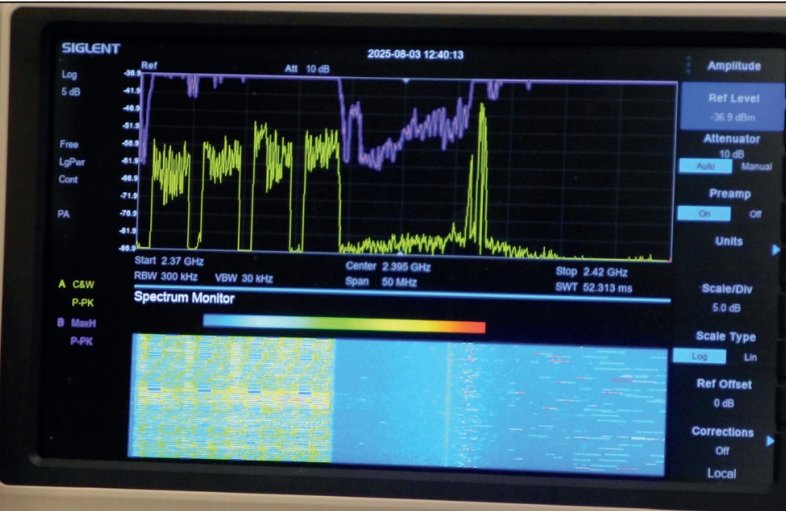
Leider gibt es einen neuen 5G-Mobilfunkmast im Umkreis von 100 Metern um die MV-Veranstaltung, und verständlicherweise war das Signal dieses Mastes sehr stark und überlagerte das gewünschte Signal der ISS (siehe Bild). Das Live-Video wurde über einen Link von Goonhilly (brit. Satelliten-Bodenstation) übertragen, und trotz der Störungen gelang es vor Ort, eine sehr kurze RX-Verbindung herzustellen. Leider war auf dem Bildschirm nur ein schwarzes Bild zu sehen, aber die Technologie hat sich bewährt.
Einige von uns haben den Neustart des HamTV mit Spannung erwartet, und obwohl es zum Zeitpunkt des Verfassens dieses Artikels noch nicht verfügbar war, hat es das Interesse in ähnlicher, aber noch größerer Weise geweckt wie der Satelliten-Transponder QO-100. Wir können nur hoffen, dass es irgendwann rund um die Uhr an 365 Tagen im Jahr sendet, idealerweise mit Videobildern der Erde oder von den Aktivitäten im Inneren des Raumschiffs. Werfen Sie einen Blick auf die Wiki-Seite:
https://wiki.batc.org.uk/HAMTV_from_the_ISS
Zur Erinnerung: Es stehen Stipendien zur Verfügung, um die Entwicklung von DATV-bezogenen Technologien zu unterstützen, sei es für neue Hardwareanwendungen, den Bau oder die Aufrüstung von Repeatern. Weitere Informationen finden Sie hier.
https://batc.org.uk/clubinfo/bursary-fund/
Gareth G4XAT
BATC-Vorsitzender
Quelle: Editorial der CQ-TV 289
Flugzeug-Scatter
1) DVB-S2-DATV
Filippo, IZ5TEP, hat uns gerade die Ergebnisse eines kürzlich erfolgten 23-cm-DVB-S2-Kontakts über Reflexion an einem (hoch fliegenden) Boeing-737-Flugzeug mitgeteilt. Filippo schreibt: „Was für ein faszinierendes Experiment! Was ich hier beschreibe, ist ein spektakuläres Beispiel für fortgeschrittene Amateurfunkkommunikation, bei der die Streuung durch Flugzeuge genutzt wird, um DVB-S2-DATV-Signale über große Entfernungen zu übertragen und dabei natürliche Hindernisse wie die Apuanischen Alpen zu umgehen.
Verbindungs-Aufbau
Sendestationen:
• IK3HHG von Treviso
• IZ5TEP von Viareggio
TX-Equipment (IK3HHG):
• 2-Meter-Schüssel mit 50 W PA
• Portsdown mit 144 MHz ZF-Ausgabe
• DB6NT Transverter für die Umsetzung nach 1296 MHz
RX Equipment (IZ5TEP):
• 2-Meter-Schüssel
• 25-dB-LNA für Empfangssignalverstärkung
• MiniTiouner mit Software von F6DZP, bekannt für Afu-DVB-S/S2-Empfang
Die Rolle des Reflektierens an Flugzeugen
Das Funksignal wird vom Rumpf eines fliegenden Flugzeugs reflektiert, wodurch es geografische Hindernisse überwinden und Entfernungen erreichen kann, die sonst in direkter Sichtlinie unmöglich wären. Diese Technik ist nicht garantiert, aber wenn sie funktioniert ... ist es pure Funkmagie!
Quelle: ATV-Journal 194
2) Slow-Scan-TV
Eine erfolgreiche SSTV-Übertragung unter Verwendung der Reflexion vom Rumpf eines (hoch) vorbeifliegenden Flugzeugs ist ein echtes Juwel und eine Hommage an technische Kreativität und operative Präzision. Die UHF-SSB-Verbindung zwischen Filippo, IZ5TEP, in Viareggio, Italien, und Francesco, IK3HHG, in Treviso – mit Francesco am Empfang – zeigt, wie Zusammenarbeit und Leidenschaft die Grenzen der konventionellen Ausbreitung überwinden können. Probieren Sie es aus, um es zu glauben. Verwendet wurden 437 und 1297 MHz.
Reflexion am Flugzeugrumpf in Bewegung. Dieses faszinierende Phänomen verwandelt ein Flugzeug in einen temporären Reflektor für Funkwellen und ermöglicht so Übertragungen, die sonst unmöglich wären. Bei SSTV ist jedes empfangene Einzelbild ein kleiner Sieg gegen die Zufälligkeiten der Atmosphäre – ein flüchtiger Moment, der durch eine perfekte Mischung aus Timing und Technik eingefangen wird.
Beobachtungen:
(1) Reflexionen von Flugzeugen bieten einzigartige Möglichkeiten für UHF/SHF-Experimente.
(2) Die analoge Natur von SSTV macht den Erfolg jeder Bildübertragung visuell lohnenswert.
(3) Die Zusammenarbeit zwischen erfahrenen Operatoren ist der Schlüssel, um diese seltenen Ausbreitungsfenster zu nutzen. Dieses Experiment ist der Beweis dafür, dass gemeinsame Leidenschaft zu bemerkenswerten Ergebnissen führt. Der SSTV-Test mit dem PD120-Modus über Luftfahrzeugreflexionen ist wirklich faszinierend, insbesondere angesichts der Entfernung und der geografischen Lage zwischen IZ5TEP und IK3HHG.
Hier ist eine kurze technische Zusammenfassung des Experiments:
Technische Ausstattung:
Stations-Entfernung ca. 300 km, getrennt durch hohe Gebirge
Funkgeräte: bei IK3HHG ICOM IC-705, bei IZ5TEP ICOM IC-905
Antennen: 2 x 180-cm-Schüsseln für 1296 MHz, 22-Element-Yagis für 430 MHz.
Quelle: ATV Journal 196
www.kh6htv.com/newsletter
SSTV-Bilder zum ARISS-Event 25 Jahre ISS
Zur Feier des 25-jährigen Bestehens der Internationalen Raumstation ISS feiert das Programm Amateur Radio on the International Space Station, kurz ARISS, dies mit der Aussendung von SSTV-Bildern. Die Amateurfunkgeräte der ARISS gehörten zur ersten Bildungsnutzlast auf der Internationalen Raumstation (ISS). SSTV-Bilder sollen vom 12. bis 20. November gesendet werden, am 12. November soll es um 17:30 UTC losgehen. Die Serie wird parallel auch das Pfadfindertum feiern. Sie besteht aus zwölf verschiedenen Bildern, die alle zwei Minuten auf 145,800 MHz in FM übertragen werden. Als SSTV-Modus wird PD120 verwendet.
Quelle: darc.de
Update:
Der erste Amateurfunkkontakt mit der ISS und RV3DR (Energia), NN1SS (NASA GSFC) und W5RRR (NASA JSC) wurde am 13. November 2000 hergestellt. Der erste ARISS-Schulkontakt mit der Burbank-Schule wurde am 21. Dezember 2000 hergestellt. Zum 25-jährigen Jubiläum wird es sechs Bilder der ISS geben, und sechs Bilder zeigen die großartige Arbeit, die die Pfadfinder leisten!
Die SSTV-Übertragung wird für zwei ARISS-Schulkontakte unterbrochen:
am 16. November von 14:30 UTC bis 15:05 UTC,
am 19. November von 10:05 UTC bis 10:30 UTC.
Dies alles wird sich auf die Verfügbarkeit von APRS auf 145,825 MHz auswirken.
Sie sind eingeladen, decodierte Bilder in die ARISS-Galerie unter folgender Adresse hochzuladen:
https://ariss-usa.org/ARISS_SSTV/
Nach dem Hochladen können Sie mit einem Klick auf die entsprechende Schaltfläche das offizielle ARISS-SSTV-Diplom beantragen.
Quelle: Jan, ON7UX
Nachtrag:
Am 12. November kam es auf der Internationalen Raumstation (ISS) zu einem Ausfall des für SSTV genutzten Amateurfunkgeräts. Das Gerät war rund zwei Stunden in Betrieb und sendete in dieser Zeit regulär SSTV-Bilder auf 145,800 MHz FM. Seitdem sendet das Gerät nur noch etwa vier Sekunden lange Träger ohne verwertbare Bilddaten. Weitere reguläre SSTV-Aussendungen sind aktuell nicht möglich.
Ersatzgerät für Schulkontakte
Für die bevorstehende Woche wurde ein Ersatzfunkgerät eingerichtet. Dieses ist jedoch ausschließlich für geplante russische ARISS-Schulkontakte vorgesehen und nicht für SSTV konfiguriert. Damit ist kurzfristig nicht mit weiteren SSTV-Aktivitäten von der ISS zu rechnen.
Quelle: darc.de
ARISS radio contact between OR4ISS and IK1SLD on November 19, 2025
Astronaut Zena Cardman, amateur radio call sign KJ5CMN, will operate the amateur radio equipment aboard the International Space Station. Zena will answer questions from students in Mexico during this live amateur radio contact. The ARISS telebridge ground station IK1SLD in Italy is conducting this radio contact for Escuela Jose Marti, Mexico City.
This live radio amateur contact is scheduled for Wednesday, November 19, 2025 at 15:34 UTC. Astronaut Zena Cardman will operate the amateur radio station call sign OR4ISS aboard the ISS and will call the ARISS telebridge ground station call sign IK1SLD in Italy. This is an ARISS telebridge contact with Escuela Jose Marti, Mexico City, Mexico. You can listen live to astronaut Zena Cardman on board the ISS at 145.800 MHz FM (plus/minus 3kHz Doppler shift).
English is the expected language of communication for this amateur radio contact.
Students Questions:
1. What is the strangest or funniest thing you've seen floating around when you were eating in space?
2. When you look out the window of the International Space Station, what makes you feel the most amazed?
3. What does it actually feel like to sleep without gravity? Do you have to tie yourself down to something?
4. If you could bring one small, fun object into space, what would it be and why?
5. Is it true that people get taller in space? And do you go back to your normal height on Earth?
6. If the ISS travels so fast, can you feel the movement, or does it feel like you are standing still?
7. What kind of science experiment are you doing right now that is the most fun or interesting?
8. How long does it take to get used to floating, and what is the hardest thing to do when you are floating?
9. What does an aurora look like from space? Is it different from seeing it from Earth?
10. What is the strangest sound you have ever heard inside the International Space Station?
11. Have you ever seen a satellite or any other space object floating by near the station?
12. What does it actually feel like to do a spacewalk, and what do you use to keep yourself from floating away from the ISS?
13. How do you wash your hair or brush your teeth in space with so little water?
14. If you could build a space station anywhere in our solar system, where would you build it and why?
15. What is the one thing you miss most about Earth that people wouldn't expect, like the smell of rain or the feeling of grass?
16. When you look down at Earth, what is the most important lesson you have learned about our planet and how we should take care of it?
ARISS activities are aimed at students and enthusiasts with the aim of inspiring them in the sciences with this demonstration of amateur radio communications from space. We invite radio amateurs and space enthusiasts to tune in to this exciting moment.
Check out the ARISS website and follow ARISS on the official social media channels for more updates.
https://www.ariss.org/contact-the-iss.html
Quelle: Jan, ON7UX
ARISS radio contact between OR4ISS and IK1SLD on November 28, 2025
Astronaut Zena Cardman, amateur radio call sign KJ5CMN, will operate the amateur radio equipment aboard the International Space Station. Zena will answer questions from students in Italy during this live amateur radio contact. The ARISS telebridge ground station IK1SLD in Italy is conducting this combined radio contact for:
- Istituto Di Istruzione Superiore "Il Tagliamento" Di Spilimbergo, Spilimbergo, Italy,
- Istituto Comprensivo "G. Mazzini", Livorno, Italy.
This live radio amateur contact is scheduled for Friday, November 28, 2025 at 11:40 UTC.
Astronaut Zena Cardman will operate the amateur radio station call sign OR4ISS aboard the ISS and will call the ARISS telebridge ground station call sign IK1SLD in Italy. This is an combined ARISS telebridge contact with Istituto "Il Tagliamento" in Spilimbergo, Italy and Istituto "G. Mazzini" in Livorno in Italy. You can listen live to astronaut Zena Cardman on board the ISS at 145.800 MHz (plus/minus 3kHz Doppler shift).
The event will be streamed live:
https://www.youtube.com/live/MgG7kcYvxWM
English is the expected language of communication for this amateur radio contact.
Students Questions:
1. How is water recycled and reused on the ISS?
2. What do you think the future of space exploration will be like?
3. How is food on the ISS?
4. Why did you decide to become an astronaut?
5. What are your feelings when you see the Earth from space?
6. How can you live in such a small space for a long time?
7. How does an astronaut's body feel when they come back to Earth.
8. How do astronauts control stress?
9. How do you grow plants on the ISS?
10. What will you miss of the ISS when back on Earth?
11. Is it comfortable to sleep in microgravity?
12. Which time zone do you use on the ISS?
13. How do you spend your free time on the ISS?
14. What are your favorite tasks or activities on the ISS?
15. Which is the funniest thing that happened during your stay?
16. How is the mental and physical training before leaving Earth?
17. Can you describe a typical day on the ISS?
18. Can you bring any objects on the ISS to remember your family?
19. What message do you like to bring to the students?
20. What do you find most unique about living and working in space?
21. Which role will artificial intelligence have in future space missions?
22. Is space better or worse than in your child's dreams?
23. Have any past experiments conducted on the ISS led to new discoveries that we now use in our lives?
24. What would you suggest to boys and girls who dream to become an astronaut?
ARISS activities are aimed at students and enthusiasts with the aim of inspiring them in the sciences with this demonstration of amateur radio communications from space. We invite radio amateurs and space enthusiasts to tune in to this exciting moment.
Check out the ARISS website and follow ARISS on the official social media channels for more updates.
https://www.ariss.org/contact-the-iss.html
ARISS-Europe News Bulletins are distributed by AMSAT Belgium. We can only maintain this service with your support.
https://www.amsat-on.be/donation-ariss-europe-news-bulletin/